
AI Agents for IDPs: Automate Infrastructure and Runbooks
Anthropic Grok Gemini
OpenAI
DALL-E
AI Agents for Internal Developer Portals: Supercharging Self-Service Infrastructure, Intelligent Docs, and Runbook Automation
Internal developer portals (IDPs) are evolving from static service catalogs into intelligent, action-oriented platforms. The catalyst is a new class of AI agents that blend large language models (LLMs), policy-aware orchestration, and deep tool integrations to automate infrastructure provisioning, surface precise answers from sprawling documentation, and execute runbooks safely. With a conversational interface—available in the portal, IDE, or chat—developers describe intent (“provision a staging cluster,” “show me error spikes,” “run the database-failover”) and the agent translates it into compliant, auditable actions. The result is lower cognitive load, faster onboarding, and fewer handoffs to platform teams. This article explains how AI agents reshape IDPs, what a secure reference architecture looks like, and a pragmatic roadmap for adoption that preserves guardrails while unlocking meaningful gains in developer productivity and operational resilience.
The Evolution of IDPs and the Rise of AI Agents
Traditional internal developer portals centralized documentation, APIs, and service catalogs but left the “last mile” to developers: interpret docs, context-switch across tools, and manually stitch together scripts. AI agents change the interaction model. Instead of navigating pages and forms, engineers express intent in natural language and receive context-aware answers or completed actions, backed by the organization’s standards. The portal shifts from a passive repository to a proactive assistant that reduces friction at every step of the software delivery lifecycle.
Combining LLMs with retrieval-augmented generation (RAG) unlocks synthesis across fragmented knowledge—wikis, READMEs, service catalogs, Slack threads, runbooks, and monitoring dashboards. Agents personalize responses based on team, service ownership, regions, and recent changes, minimizing stale guidance. Because these agents integrate with CI/CD, observability, and cloud APIs, they do more than retrieve links: they orchestrate multi-step workflows, validate policy compliance, and report status in real time.
Critically, this isn’t about replacing platform engineering. Agents eliminate toil—tickets, repetitive commands, and rote troubleshooting—so platform teams can focus on golden paths, architecture, and reliability engineering. Over time, interaction histories and incident timelines teach agents which remediations work best, transforming static knowledge into a continuously improving operational memory.
Conversational Self‑Service Infrastructure as Code
Self-service infrastructure often stalls at complexity: IaC templates, parameter sprawl, and vendor-specific quirks. AI agents act as an intent-to-IaC translator. A developer can request, “Create a temporary staging environment for auth-service with a small Redis cache and public access,” and the agent maps that to approved components, generates Terraform or Pulumi, validates against policies, and kicks off provisioning. Human-friendly defaults reflect organizational standards—naming, tagging, networking, and observability come “baked in,” not as afterthoughts.
Guardrails ensure speed doesn’t compromise safety. Before execution, the agent checks quotas, cost ceilings, network exposure, and compliance baselines. If a request violates policy—say a public S3 bucket or unencrypted database—the agent proposes secure alternatives or routes the action through an approval gate. This approach delivers autonomy with control, enforcing golden paths while avoiding ticket queues. The benefits compound:
- Faster onboarding: New hires can ship without mastering your cloud topology or IaC syntax.
- Embedded best practices: Security, cost tagging, and observability are applied by default.
- Smarter cost posture: The agent recommends right-sized instances and schedules auto-teardown for ephemeral environments.
Over time, agents learn from outcomes. If teams consistently resize certain databases, the agent adjusts recommendations. In hybrid or multi-cloud settings, the agent abstracts away provider differences, translating intents into vendor-agnostic blueprints. Some organizations report double-digit cost improvements—often 20–50% in practice—by combining intelligent recommendations, automated cleanup, and fewer misprovisioned resources.
Dynamic, Context‑Aware Documentation and Knowledge
Documentation sprawl is universal: crucial details live across Confluence, Git repos, ADRs, and tribal knowledge in chat. AI agents transform this chaos into a unified knowledge interface. With semantic search and RAG, the agent answers nuanced questions—“What’s the hotfix path for billing-api in EU and who approves?”—by synthesizing the relevant runbook steps, ownership metadata, and policy documents into one coherent response, complete with links, code snippets, and recent updates.
Context is the difference between “searching” and “knowing.” The agent tailors answers to the developer’s team, the service they’re editing, and the current state of the system. Embedded in the IDE or Slack, it proactively surfaces architecture diagrams, API contracts, recent incidents, or deprecation notices, right when they matter. Instead of breaking flow to hunt down sources, developers stay focused, with the portal bringing the right information to them.
Agents also close gaps. By tracking unanswered or frequently asked questions, they flag stale docs, create tickets, or draft updates from code diffs and PR descriptions. They can attach versions to services in the catalog so responses reflect the correct release line. The payoff is tangible: fewer interrupts, clearer ownership, and a living body of documentation that evolves as fast as the codebase.
AI‑Powered Runbooks and Incident Response
Static runbooks are indispensable but brittle under pressure. AI agents convert them into executable, adaptive workflows. When latency spikes, the agent correlates alerts, checks recent deployments, inspects logs and metrics, and suggests or executes the next step—scaling replicas, rolling back, clearing a cache—subject to permissions and confirmations. Every action is logged with before/after state to create a precise audit trail.
Because the agent learns from history, it doesn’t just follow a script. If a standard remediation fails, it tries proven alternatives observed in prior incidents and updates the playbook afterward. During an outage, on-call engineers can ask, “Show error rates and CPU for checkout-service last 30 minutes,” then “Run database-failover in prod,” and the agent orchestrates verification, approvals, and downstream checks. This augments both veteran SREs and newer engineers, compressing mean time to detect and resolve.
Safety remains paramount. High-impact operations require explicit confirmation and may incorporate multi-party approvals or time-of-day constraints. Post-incident, the agent produces timelines, highlights effective steps, and proposes edits to runbooks. The cumulative effect is lower cognitive load, faster MTTR, and a platform that gets smarter with every incident.
Reference Architecture, Integrations, and Security Guardrails
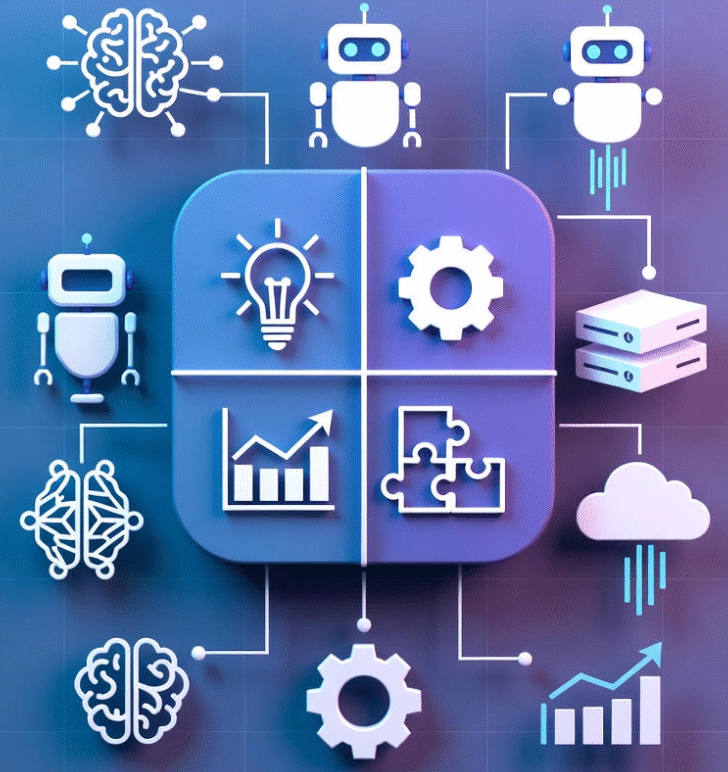
A practical AI agent for an IDP comprises four pillars: an NLU/LLM core (commercial or open-source), contextual data connectors (docs, code, service catalog, observability), an action engine (to run templates, call APIs, trigger jobs), and guardrails (permissions, policy-as-code, audit). The portal becomes the control plane that unifies these components and exposes a consistent conversational UX across web, IDE, and chat.
Security design should start with authorization. Prefer user-delegated access—the agent acts with the calling user’s effective permissions via SSO/OIDC and RBAC. Where service identities are necessary (e.g., CI runners), scope them to least privilege and require the agent to verify the initiating user’s authorization before execution. Combine this with policy-as-code (Open Policy Agent, Cedar), environment scoping (read-only in prod by default), just-in-time elevation for sensitive tasks, and comprehensive audit logging of prompts, retrieved context, decisions, and actions.
Integrate broadly but deliberately. High-value systems typically include:
- Version control and CI/CD: GitHub/GitLab, Jenkins, Argo, or Spinnaker for code, pipelines, and scaffolding.
- Cloud and orchestration: AWS, GCP, Azure, Kubernetes, Terraform/Pulumi for provisioning and lifecycle management.
- Observability and incident tools: Datadog, Prometheus, Grafana, Splunk, PagerDuty for metrics, logs, traces, and paging.
- Knowledge and service catalog: Backstage, Confluence, Markdown repos for docs, ownership, policies, and golden paths.
A careful data-handling policy—masking secrets, filtering PII, and constraining external LLM calls—ensures responses are helpful without leaking sensitive information.
A Practical Roadmap: Adoption, Governance, and Metrics
Win trust with phased delivery. Start read-only: semantic search, Q&A over documentation, and observability queries. Demonstrate accuracy and utility before enabling changes. Next, permit low-risk actions in non-production—run a diagnostic script, scaffold a service, or provision ephemeral test environments with auto-teardown. As confidence grows, expand to controlled production actions with approval gates and rollback automation.
Change management matters as much as tooling. Socialize clear “what the agent can do” boundaries, publish example prompts, and embed the assistant where developers already work (portal, IDE, Slack). Nominate champions in each team to collect feedback and propose new skills. Treat the agent like a product: maintain a backlog, release notes, and SLAs for integration quality. Platform engineering remains accountable for the golden paths the agent enforces.
Measure outcomes to guide investment. Track reduction in platform tickets, time-to-provision, MTTR, agent-assisted remediation rate, documentation satisfaction, and cost drift for ephemeral environments. Establish baselines pre-rollout, review weekly during pilots, and quarterly post-GA. Tie results to tangible goals—accelerated onboarding, fewer interrupts for platform teams, and improved service reliability—so leadership sees progress and teams prioritize the next set of automations.
FAQ
Below are concise answers to common questions teams ask when planning or scaling AI agents inside their internal developer portals.
How do AI agents differ from simple chatbots in an IDP?
Chatbots mostly retrieve information along scripted paths. AI agents understand intent, maintain context across steps, and can take action by generating IaC, calling APIs, triggering pipelines, and executing runbooks. They integrate with your systems, enforce policies, and learn from outcomes, enabling complex, multi-step workflows rather than just link sharing.
What’s the safest way to give an agent access to infrastructure?
Prefer user-delegated access so the agent never exceeds the caller’s RBAC/IAM permissions. When a service identity is required, apply least privilege, environment scoping, and explicit approvals for high-impact tasks. Combine with policy-as-code guardrails, immutable audit logs, and sandbox/staging execution by default before production rollout.
Can AI agents replace platform engineering teams?
No. Agents augment platform teams by automating toil and enforcing golden paths. Humans still design architectures, evolve the platform, resolve novel edge cases, and prioritize which capabilities the agent should expose. The payoff is leverage: the same team can support more developers with higher reliability.
Build ourselves or buy a vendor solution?
You can prototype quickly with LLM APIs and frameworks, but production-grade agents require sustained investment in integrations, security, policy, and observability. Vendors can accelerate time-to-value with prebuilt connectors and enterprise controls; a hybrid path is common—start with build for core use cases, then adopt vendor modules where they reduce risk or maintenance burden.
How much organizational data is needed for useful results?
With RAG over your existing docs, runbooks, and service catalog, teams see value in weeks. More sophisticated behaviors emerge as you add incident timelines, change logs, and interaction histories. Continuous learning—curating agent successes and refining prompts and policies—drives steady improvement without massive up-front datasets.
Conclusion
AI agents elevate internal developer portals from reference hubs to actionable control planes. By translating natural-language intent into compliant infrastructure, surfacing precise, context-aware knowledge, and executing adaptive runbooks with strong guardrails, they compress cycle times and reduce operational toil. The winning pattern is clear: start read-only, add low-risk actions in staging, enforce policy-as-code and user-delegated permissions, then expand to high-value production workflows with approvals and rollbacks. Measure impact on provisioning time, MTTR, platform ticket volume, and cost posture to guide iteration. With thoughtful security, integration, and change management, AI-powered IDPs become a durable competitive advantage—freeing engineers to focus on innovation while the portal anticipates needs and handles the heavy lifting.