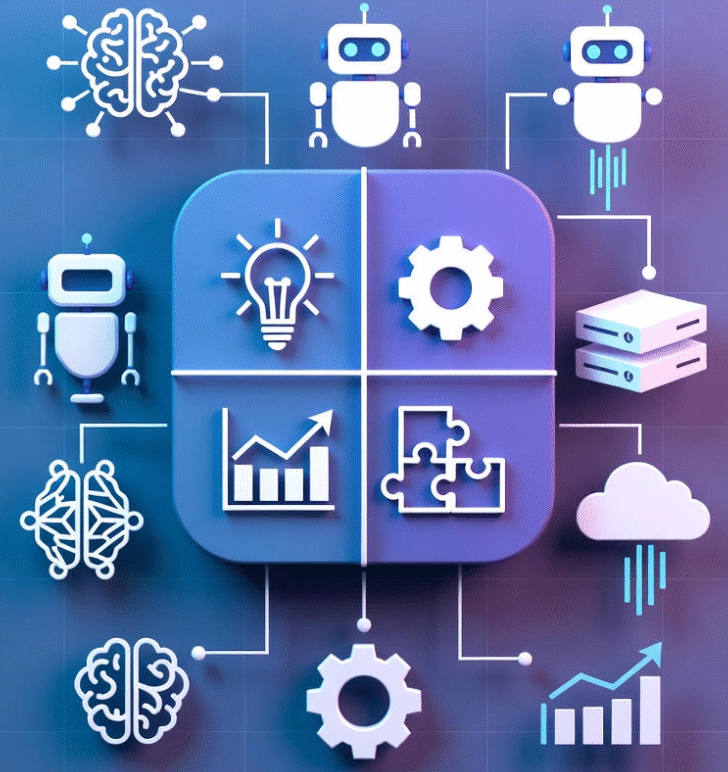

Agentic AI: Practical Guide to Scalable Autonomous Agents
Grok OpenAI Anthropic
Gemini
DALL-E
Future of Agentic AI: A Practical Guide to Autonomous Systems and Responsible Scaling
Agentic AI represents the next evolutionary leap in artificial intelligence, moving beyond systems that merely predict or classify to those that can independently plan, decide, and act to achieve goals. These autonomous agents combine the reasoning power of large language models (LLMs) with tools, memory, and feedback loops to execute complex, multi-step tasks across both digital and physical environments. This shift matters because it moves AI from a passive assistant to a proactive collaborator, capable of orchestrating entire workflows, navigating real-world constraints, and improving over time. From instrumented copilots that assist human experts to semi-autonomous systems that manage entire processes, the future lies in safe, reliable delegation. This comprehensive guide explores the architectural foundations, technological ecosystem, business value, governance frameworks, and human collaboration patterns necessary to build agentic systems that are not just impressive demos, but dependable, production-ready products.
What is Agentic AI? Beyond Traditional Automation
The core distinction between conventional AI and agentic AI lies in autonomy and intentionality. Traditional automation, like Robotic Process Automation (RPA), follows rigid, pre-programmed scripts. It executes tasks but cannot reason or adapt to unforeseen variability. Conventional AI, including most chatbots, operates in a reactive mode, responding to explicit instructions for each action. Agentic AI, in contrast, operates with a degree of self-direction. It interprets high-level, ambiguous goals, breaks them down into actionable steps, selects the right tools for the job, monitors its progress, and adjusts its strategy without constant human oversight.
This evolution represents a fundamental shift from reactive to proactive intelligence. An agentic system embodies what researchers call “goal-directed behavior”—the ability to maintain focus on a long-term objective while navigating obstacles and uncertainties. It doesn’t just answer a question; it anticipates needs, orchestrates resources, and executes a plan. For example, instead of just telling you the weather, an agentic travel assistant might see a flight cancellation in your email, check your calendar for conflicts, find alternative flights that fit your schedule and budget, and present you with a rebooked itinerary for one-click approval.
This capability is not magic; it’s built on a convergence of technological breakthroughs. Advanced LLMs provide the core reasoning engine. Sophisticated memory systems—both short-term for context and long-term via vector databases—allow agents to learn from experience. Tool-use capabilities, enabled by function calling and API integration, empower agents to interact with the outside world. Together, these components create systems that can serve as true collaborators and problem-solvers, making agentic AI fundamentally more powerful than the automation tools that preceded it.
Architectural Foundations of Autonomous Agents
Modern agentic architectures are built by layering planning, memory, and tool-use capabilities on top of foundation models. The agent’s ability to reason and strategize is enabled by advanced planning techniques. Frameworks like ReAct (Reason and Act) allow an agent to verbalize its chain of thought and then select an action, while methods like Tree-of-Thoughts enable it to explore multiple reasoning paths and self-correct. For complex, long-horizon tasks, these planners let an agent decompose a primary goal into a sequence of manageable sub-tasks and revise its approach based on new information.
Effective action requires robust memory systems. Agents utilize several types of memory to maintain context and learn. Episodic memory stores the history of recent interactions, providing short-term context. Semantic memory, often implemented with vector databases, allows the agent to retrieve relevant knowledge from vast document stores. Finally, structured memory can be used to store and recall learned procedures or user preferences, enabling the agent to improve its performance over time. This ability to remember and retrieve information is what separates a one-shot tool from a persistent, learning agent.
Complex problems often benefit from multi-agent systems, where a team of specialized agents collaborates to achieve a goal. For example, a “researcher” agent might gather information, a “planner” agent could formulate a strategy, and a “critic” agent could verify the plan and identify potential flaws. These agents coordinate via shared memory spaces or message buses, creating a robust system of checks and balances that reduces the risk of hallucination and improves the quality of the final output. This modular approach allows developers to build more resilient and capable systems than a single, monolithic agent could provide.
Crucially, not all autonomy is equal. Production-ready systems must incorporate varying levels of agency based on risk and context. These levels range from advisory copilots that only suggest actions, to gated executors that require human approval for high-stakes steps, to semi-autonomous agents that operate within predefined policies, and finally to fully autonomous agents reserved for low-risk, high-trust scenarios. Implementing clear stop conditions, rollback mechanisms, and human escalation paths is non-negotiable for ensuring reliable and safe operation in the real world.
The Technology Stack and Ecosystem
The agentic AI stack is rapidly maturing around a set of interoperable components designed to support the core perceive-plan-act loop. Orchestration frameworks like LangChain or LlamaIndex coordinate the flow between the agent’s reasoning engine (the LLM), its tool catalog, its memory stores, and its evaluation systems. Vector databases provide the low-latency retrieval needed for semantic memory, while knowledge graphs can encode complex constraints and relationships to ground the agent’s reasoning in factual data. This platform approach turns bespoke prototypes into scalable, maintainable services.
Interoperability and efficiency are paramount for production deployment. Standardized function schemas and shared tool registries are emerging to reduce the amount of custom “glue code” needed to connect agents to external systems. To manage costs and latency, developers are increasingly adopting model routing, a technique where different models are used for different tasks. A small, fast model might handle simple classification, a mid-size model could manage structured reasoning, and a powerful, state-of-the-art model is reserved for novel planning and creative generation. Techniques like caching, speculative decoding, and parallel tool calls further optimize performance for high-throughput applications.
As agents move from development to production, operational discipline becomes critical. Building a robust agentic platform requires planning for:
- Latency Budgets: Ensuring timely responses through efficient model routing, step-batching, and parallel execution of independent tasks.
- Determinism Controls: Managing the inherent randomness of LLMs with temperature scaling, constrained tool usage, and defined retry policies to ensure consistent behavior.
- Observability: Turning opaque chains of thought into auditable pipelines with traces, token-level logs, and replayable sessions for debugging and compliance.
li>Safety Sandboxes: Isolating risky actions within controlled environments using role-based access control (RBAC), network egress policies, and strict rate limits.
Practical Applications and Business Value
Agentic systems deliver the most significant return on investment in workflows that are semi-structured, repetitive, and high-volume, yet still require cognitive judgment. These are tasks that are too complex for traditional RPA but too tedious for highly skilled human experts to perform at scale. Early successes are emerging across multiple industries, transforming core business operations.
In customer service, agents are moving beyond simple chatbots to become end-to-end resolution engines. They can understand nuanced customer issues, access order histories, coordinate with logistics APIs to track packages, process refunds, and update CRM records—all without human intervention. In financial services, autonomous agents monitor market data, execute trades based on sophisticated strategies, rebalance portfolios according to risk policies, and perform complex invoice matching and reconciliation. For software development and DevOps, agents act as collaborators that write code, debug applications, execute runbooks to resolve incidents, and optimize cloud infrastructure based on performance metrics.
Successful agentic products combine clarity with control, empowering users without creating uncertainty. Winning product patterns often include:
- Plan-then-Act UIs: Interfaces that show the user the agent’s proposed plan of action and require confirmation before execution.
- Policy-Aware Agents: Systems with explicit, configurable guardrails, such as spending caps, data access scopes, or communication guidelines.
- Self-Verification Loops: Architectures where a secondary “critic” agent or an external validation tool checks the primary agent’s work before it’s finalized.
- Outcome Dashboards: Analytics that track key performance indicators (KPIs) like time saved, error rate reduction, and direct business impact.
To build a strong business case, organizations must first establish agent readiness by documenting processes, ensuring clean data, and exposing reliable APIs. The most successful adoption strategy involves staged autonomy: start with an agent in read-only mode, then introduce gated write capabilities, and only then move to partial automation, tying each stage to measurable improvements in efficiency, quality, or revenue.
Governance, Safety, and Ethical Considerations
Trust is the foundation of autonomy. As agents gain the ability to take consequential actions, a multi-layered approach to safety and governance becomes essential. Production-grade systems require defense in depth, starting with input hardening to defend against prompt injection and output controls to ensure responses adhere to predefined schemas and policies. Execution should occur in sandboxed environments with least-privilege credentials to limit the potential impact of errors or malicious attacks. Finally, immutable audit trails that log every thought, decision, and action are critical for debugging, compliance, and accountability.
The proliferation of agentic AI also raises profound ethical questions that demand proactive attention. Chief among these is accountability: when an autonomous agent makes a mistake, who is responsible? The distributed nature of agentic decision-making complicates traditional legal frameworks, requiring new paradigms for liability. The potential for job displacement in knowledge work is real, necessitating a focus on upskilling and evolving roles toward human-AI collaboration. Furthermore, as agents require vast data access, ensuring user privacy and preventing bias amplification from training data are critical ethical imperatives.
Regulatory expectations are rising to meet these challenges. Frameworks like the NIST AI Risk Management Framework (RMF) and standards such as ISO/IEC 42001 provide structured approaches for managing AI systems responsibly. Legislation like the EU AI Act will mandate transparency, human oversight, and post-market monitoring for high-risk applications. For agentic systems, this means that features like explainability, auditability, and human-in-the-loop controls are not just best practices—they are becoming legal requirements. Governance isn’t a blocker to innovation; it’s the license to scale it responsibly.
The Future of Work: Human-AI Collaboration
Rather than replacing human experts, the most effective agentic systems are designed to augment their judgment. The winning paradigm is human-in-the-loop (HITL) collaboration, where agents handle the repetitive, data-intensive aspects of a task while humans provide strategic direction, handle exceptions, and make high-stakes decisions. The best products feel like a partnership, with agents explaining their plans, citing their sources, and accepting corrections that improve their future performance. This collaborative approach fosters trust and allows for gradual, safe delegation of responsibility.
Designing for this partnership requires a focus on transparency and user control. Effective interfaces include features like:
- Explainable Plans: Clear visualizations of the agent’s proposed steps, along with the rationale behind its choices.
- Reversible Actions: Simple, one-click rollback mechanisms that allow users to undo an agent’s actions if they produce an undesirable outcome.
- “Why Not?” Prompts: When an agent declines a task due to policy constraints, it should explain which rule it would violate.
- Skill Portfolios: Giving users the ability to enable or disable specific agent capabilities based on their comfort level and the context of the task.
The impact on the workforce will be pragmatic and evolutionary. Roles will shift from task execution to system oversight. Professionals will become AI conductors who curate tools, author policies, review outcomes, and train agents. Core competencies will evolve to include prompt engineering, process design, and data hygiene. Looking ahead, the integration of agentic AI with physical robotics will unlock new frontiers in manufacturing and logistics, while deeply personalized agents will manage our digital lives. The ultimate goal is not full automation, but the creation of powerful hybrid teams that combine human creativity and ethical judgment with the speed and analytical power of AI.
Conclusion
The future of agentic AI is practical, outcomes-driven, and built on a foundation of trust. Systems that can plan, remember, and act within clear, governable policies are rapidly moving from flashy prototypes to dependable digital teammates. Success in this new era requires a holistic approach. Organizations must invest in a robust architecture that masters planning, memory, and tool use; build a mature platform with strong observability and cost controls; and focus relentlessly on creating measurable business value. This ambition must be balanced with rigorous governance, including layered safety, auditable processes, and alignment with emerging regulations. Most importantly, we must design for human partnership, creating transparent, controllable systems with feedback loops that compound learning and build trust. By orchestrating these pieces thoughtfully, agentic AI will not just automate tasks; it will elevate human expertise, unlock new forms of innovation, and create durable competitive advantage.
What distinguishes agentic AI from traditional automation or RPA?
The key difference is reasoning and adaptability. Traditional automation like RPA follows fixed, brittle scripts to execute structured tasks. Agentic AI, powered by LLMs, reasons in natural language, can understand ambiguous goals, dynamically selects tools to achieve them, and adapts its approach to novel situations. It blends unstructured understanding with structured actions, making it far more resilient to real-world variability.
How do I measure the success of an agentic system?
Success should be measured against business KPIs tied directly to the tasks the agent performs. Key metrics include cycle time reduction, error rate decrease, SLA adherence, and direct revenue or cost-saving impact. These should be paired with safety and trust indicators, such as policy violation rates, rollback frequency, and human approval rates for agent-proposed plans.
What are the primary safety and ethical concerns?
The primary concerns center on reliability, accountability, and alignment. Safety risks include agentic systems making errors in high-stakes environments due to model hallucinations or flawed planning. Ethical concerns involve determining accountability when an autonomous agent causes harm, the potential for job displacement in knowledge work, and ensuring agents are aligned with human values and do not amplify societal biases present in their training data.
How will agentic AI impact jobs and professional skills?
Agentic AI will likely automate repetitive cognitive tasks rather than entire jobs, shifting the focus of professional roles. Skills that complement AI—such as creative problem-solving, strategic thinking, ethical judgment, and complex relationship management—will become more valuable. Professionals will need to learn how to effectively collaborate with, manage, and oversee AI agents, evolving into roles like “AI conductor” or “AI trainer” who curate tools and define policies for their digital counterparts.