Graph RAG: Boost Retrieval Accuracy with Knowledge Graphs
Grok Anthropic OpenAI
Gemini
DALL-E
Graph RAG: Enhancing Retrieval with Knowledge Graphs and Relationships
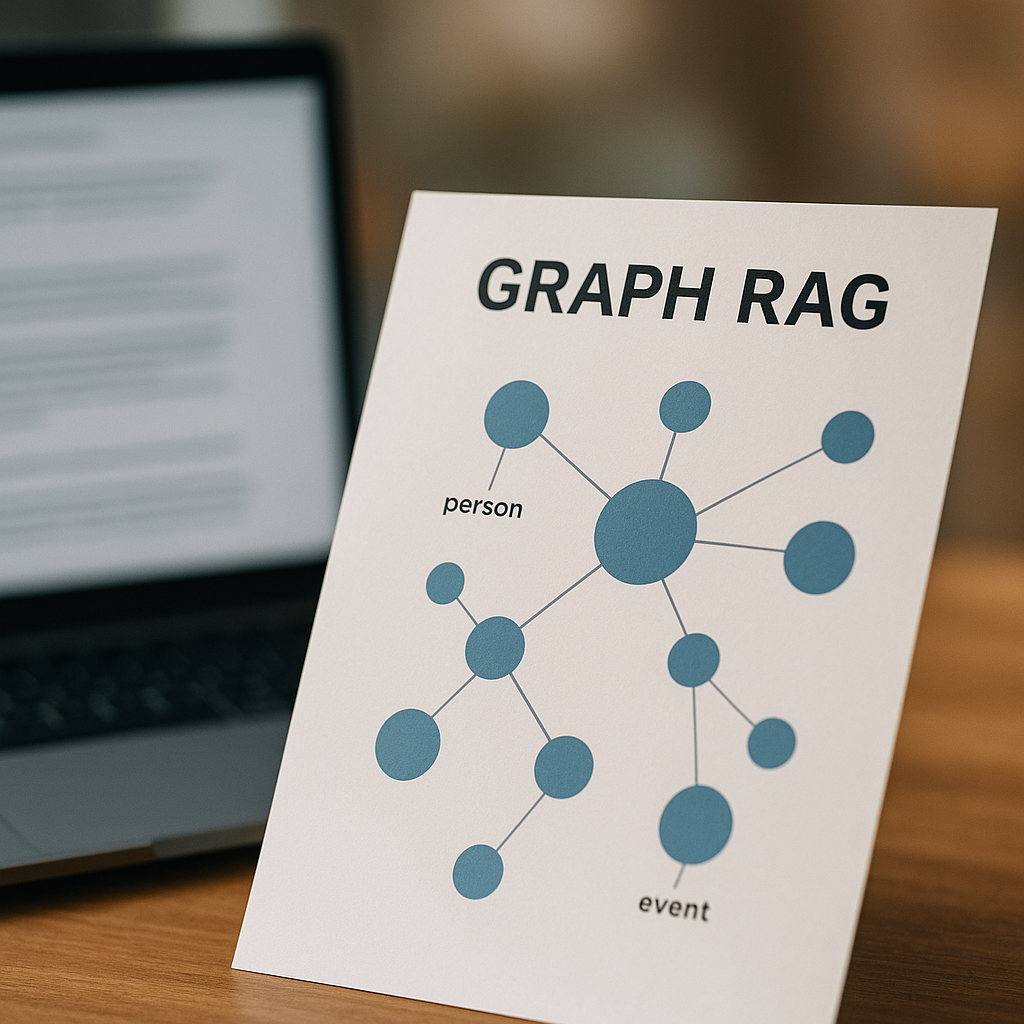
Graph RAG (Retrieval-Augmented Generation) represents a transformative evolution in AI, fusing the semantic search capabilities of traditional RAG with the structured power of knowledge graphs. Instead of retrieving isolated text chunks, this advanced approach leverages a network of interconnected entities and relationships—people, products, events, and how they connect—to provide contextually rich, relationship-aware answers. By mapping unstructured content to a knowledge graph, Graph RAG enables large language models (LLMs) to reason over information that mirrors real-world structure. This architecture delivers more accurate, explainable, and nuanced responses, significantly reducing hallucinations and unlocking the ability to answer complex, multi-hop queries. For organizations in domains like finance, healthcare, and enterprise knowledge management, Graph RAG turns scattered data into a coherent, query-ready asset, delivering trustworthy insights grounded in verifiable connections.
The Limitations of Traditional RAG: Why Graphs Are the Next Frontier
Traditional Retrieval-Augmented Generation systems revolutionized how LLMs access external knowledge, but they possess inherent limitations. Standard RAG implementations typically chunk documents into text segments, embed them in a vector space, and retrieve relevant passages based on semantic similarity. While effective for straightforward queries, this approach struggles with multi-hop reasoning and questions that require a deep understanding of the relationships between different pieces of information. The model can find related concepts, but it often fails to understand the precise nature of their connection.
Consider a query like, “What companies did the former CEO of Tesla invest in after leaving?” A conventional RAG system might retrieve documents about Tesla’s CEO and separate articles about various investments. However, it lacks the structural understanding to connect these pieces coherently into a single, accurate answer. The absence of explicit relationship modeling means the system cannot easily traverse connections between entities—like “person,” “former employer,” and “investment”—limiting its ability to answer complex queries that require following a logical chain of relationships across multiple sources.
Furthermore, traditional vector-based retrieval often suffers from context fragmentation. When documents are split into chunks, critical information spanning multiple sections can be lost or disconnected. A paragraph might mention a company’s acquisition, while another details the subsequent leadership changes. A chunk-based system sees these as separate facts, whereas a knowledge graph can link them with a “resulted_in” edge. This fragmentation problem is especially acute in technical, legal, and scientific domains, where understanding relationships between concepts, citations, and events is paramount for accurate comprehension and response generation.
How Graph RAG Architecture Works: A Hybrid Approach
Graph RAG fundamentally reimagines the retrieval process by constructing a knowledge graph (KG) from source documents before the retrieval stage. This involves using techniques like named entity recognition (NER) and relation extraction to identify key entities (people, organizations, locations, concepts) and the relationships that connect them. The resulting graph becomes a rich semantic network where nodes represent entities and typed edges (e.g., “owns,” “cites,” “is_located_in”) encode the context connecting them. This structured layer allows retrieval to move beyond simple similarity and traverse meaningful pathways that reflect real-world logic.
The retrieval mechanism in Graph RAG typically follows a multi-stage flow. First, the system parses the user’s query to detect entities, normalize them to canonical IDs, and infer the user’s intent (e.g., “compare,” “trace,” “explain”). Next, it generates candidate information using a hybrid retrieval strategy. This combines semantic vector search for broad conceptual recall, keyword search (like BM25) for precise term matching, and graph expansion to surface structurally relevant information by exploring the k-hop neighborhood of query entities or following specific relationship types.
This relationship-aware context is then passed to the LLM. Instead of receiving a list of disconnected text chunks, the model gets a structured, interconnected set of facts. This allows it to produce responses that reflect a genuine understanding of how entities relate, support complex reasoning chains, and provide explanations grounded in the actual structure of the knowledge base. Crucially, most Graph RAG implementations maintain both graph connectivity and vector representations, combining the strengths of both worlds: structured reasoning for precise relationship queries and semantic search for broader conceptual questions.
Building a Retrieval-Ready Knowledge Graph
The success of a Graph RAG system hinges on the quality and utility of its underlying knowledge graph. The design process must begin with an ontology created specifically for retrieval tasks, not just data warehousing. This involves defining high-value node types (e.g., Organization, Product, Risk, Regulation) and typed relationships (e.g., “supplies,” “contradicts,” “supersedes”) that directly map to the kinds of questions users will ask. Attributes that drive ranking and filtering—such as time, confidence scores, provenance, and geography—should be modeled directly on nodes and edges to enable precise retrieval.
Entity resolution and provenance are critical for building a trustworthy graph. The system must canonicalize entities across all data sources, merging different aliases, IDs, and codes into a single “golden” identity. Equally important is attaching metadata to every piece of information. Each edge should store its source document, the extraction confidence score, and timestamps (e.g., `validFrom`/`validTo`) to enable “as-of” queries that reflect how knowledge changes over time. Where nuance is critical, the model can capture polarity (supports vs. refutes), quantifiers (approximate vs. exact), and degrees of uncertainty.
Pragmatic design choices are essential for creating a graph that is both powerful and performant. A successful pipeline balances sophistication with practicality.
- Design choices that boost retrieval: Use lightweight schemas focused on frequent query patterns; assign edge weights that reflect business value or evidence strength; pre-compute and store metapaths representing common analytical journeys (e.g., “Supplier → Shipment → Delay”); and anchor graph nodes directly to text spans in source documents for precise quoting and citation.
- Pragmatic ingestion strategies: Combine rule-based extraction with more flexible LLM-based extraction; enforce a strict schema with data validators; maintain a centralized service for entity reconciliation; and use incremental updates to keep the graph current without requiring full, costly rebuilds.
Key Advantages and High-Impact Use Cases
Graph RAG delivers substantial improvements in reasoning capabilities, particularly for queries requiring multi-hop inference. In domains like financial analysis, pharmaceutical research, or intelligence gathering, understanding complex chains of relationships is crucial. The system can answer questions like, “Which board members are common between competing pharmaceutical companies developing Alzheimer’s treatments?” by traversing relationship paths that would be nearly impossible to reconstruct from disconnected text chunks.
The architecture also significantly reduces hallucinations and improves factual accuracy. Because responses are grounded in an explicit, verifiable network of relationships extracted from source documents, the LLM is less likely to fabricate connections or misrepresent how entities relate. The graph structure itself serves as a constraint mechanism that prevents the generation of relationships that don’t exist in the knowledge base, providing a powerful layer of reliability and trust.
Explainability and transparency also improve dramatically. Since the system retrieves structured subgraphs rather than opaque text chunks, it can visualize exactly which entities and relationships informed a response. This allows users and auditors to inspect the reasoning chain, verify connections, and understand the provenance of information in a way that traditional RAG systems cannot easily support. This traceability is essential in regulated industries where decision provenance is as important as the answer itself.
Enterprise knowledge management is one of the most compelling applications for Graph RAG, especially for organizations with vast repositories of interconnected documents. Key use cases include:
- Business Intelligence: Analyzing market relationships, competitor networks, and complex supply chain dependencies to identify risks and opportunities.
- Legal and Compliance: Tracking precedent relationships, case citations, and judicial reasoning chains, or mapping requirements across interconnected regulations and policies.
- Scientific and Medical Research: Connecting research methodologies, experimental results, and citation networks to uncover hidden patterns and accelerate discovery.
- Customer Support: Building systems that understand product relationships, component dependencies, and complex troubleshooting sequences to provide faster, more accurate help.
Implementation Patterns and Technical Considerations
Deploying a Graph RAG system requires a hybrid architecture that integrates graph databases (like Neo4j, Amazon Neptune, or TigerGraph) with vector stores (like Pinecone, Milvus, or Elasticsearch). Common implementation patterns include a sidecar graph that enriches an existing vector-based RAG system, an integrated store that offers both vector and graph capabilities, or a pipeline-oriented approach where graph features and paths are pre-computed and stored for fast retrieval.
However, building such a system presents several technical challenges. The quality of entity and relationship extraction is paramount; errors or inconsistencies in the extraction pipeline will directly degrade graph quality and retrieval accuracy. Organizations must invest in robust extraction models, validation workflows, and sophisticated entity resolution to ensure the graph is a reliable source of truth. Furthermore, graph traversal can be computationally intensive. Performance optimization through indexing, caching frequent subgraphs, and limiting query depth (k-hop expansions) is critical to keep latency within acceptable user experience targets (e.g., under 2.5 seconds).
Maintaining the knowledge graph introduces operational complexity not found in simpler RAG systems. As source documents are added or updated, the system must perform dynamic graph maintenance—re-extracting entities, reconciling conflicts, and updating graph structures without disrupting service. This requires a mature data pipeline capable of handling versioning, change propagation, and temporal reasoning. Finally, the learning curve can be steep, as teams need to develop expertise in graph modeling, query languages like Cypher or Gremlin, and graph algorithms.
The Future of Intelligent Retrieval: Emerging Trends
The field of Graph RAG is rapidly evolving, with several exciting trends on the horizon. The convergence of graph neural networks (GNNs) with Graph RAG promises to unlock more sophisticated reasoning. GNNs can learn representations that inherently encode graph structure, enabling systems to understand not just explicit, extracted relationships but also implicit patterns and higher-order connections. This could lead to more nuanced and predictive insights directly from the graph’s topology.
Automated ontology construction and schema evolution will likely become more prevalent, reducing the significant manual effort currently required. Instead of relying on human experts to design a schema, next-generation systems may use LLMs to automatically discover entity types, relationship categories, and hierarchical structures from the documents themselves. This self-organizing knowledge representation would dramatically lower the barrier to entry and allow Graph RAG to adapt more fluidly to new and evolving information domains.
The expansion into multi-modal knowledge graphs is another promising direction. Real-world knowledge is often contained in images, tables, and diagrams. Future systems that can extract entities and relationships from these diverse formats will provide a much richer contextual understanding. Finally, the integration of deep temporal reasoning will enable Graph RAG to answer complex questions about how relationships and networks evolve over time, a critical capability for business intelligence, historical analysis, and trend identification.
Conclusion
Graph RAG elevates retrieval from “best matching text” to best supported reasoning. By embedding knowledge graphs and explicit relationships into the retrieval pipeline, this approach delivers the deeper context, stronger explainability, and fewer hallucinations that enterprises demand. It addresses the core weaknesses of traditional vector-only methods by building a system that understands not just words, but how the world is connected. While implementation requires a thoughtful investment in graph modeling, extraction pipelines, and hybrid architectures, the payoff is substantial: a more intelligent, reliable, and trustworthy AI system. As organizations continue to scale their data ecosystems and demand more from their generative AI applications, the fusion of graphs and LLMs offers a practical and powerful path forward to unlocking true, relationship-aware intelligence.
What is the main difference between traditional RAG and Graph RAG?
Traditional RAG retrieves isolated text chunks based on semantic similarity, treating documents as a flat collection of information. Graph RAG first builds an interconnected knowledge graph by extracting entities and relationships. This allows it to understand how information connects across different documents, enabling sophisticated multi-hop reasoning and relationship-aware responses that traditional RAG cannot provide.
Does Graph RAG completely replace vector-based retrieval?
No, most modern Graph RAG implementations use a hybrid approach that combines graph structures with vector embeddings. The knowledge graph excels at capturing explicit relationships and enabling logical traversal, while vector search is ideal for semantic similarity and fuzzy matching. This combination leverages the strengths of both technologies for more comprehensive and robust retrieval performance.
Will Graph RAG slow my system down?
Graph traversal can add latency compared to a simple vector lookup. However, this overhead is managed through careful system design. Techniques like limiting the depth of graph searches (k-hop limits), using edge-type filters, caching popular subgraphs, and pre-computing common relationship paths (metapaths) can keep query performance competitive. In practice, many users find the trade-off of a small delay for significantly more accurate and context-rich answers is well worth it.
How do I migrate from classic RAG to Graph RAG?
A pragmatic approach is to start small and iterate. Begin by extracting a few high-impact entity and relationship types from your existing documents. Link these new graph elements to the original text passages. You can then introduce graph-based re-ranking as an initial step, where graph signals are used to boost the relevance of candidates from your existing vector search. From there, you can gradually expand your ontology, improve extraction quality, and introduce more advanced graph traversal techniques based on evaluation data and user feedback.